How to Get Rid of Bees Without Killing Them (Orlando Guide)
5 min read
You've got bees where you don't want them, and you want them gone. Fair enough. I'm James Caperton, The Other Bee Guy, and I've been keeping bees in Central Florida for 12 years. Here's the honest version of how to get rid of bees, including the "quick fixes" that make the problem worse.
The short answer: figure out what you have first. A swarm usually leaves on its own. A colony that has moved into your wall, roof, or shed won't, and it has to be removed, comb and all.
Step 1: Make Sure They're Honeybees
Not every buzzing insect is a honeybee, and the right move depends on what you've got.
| What it looks like | What to do | |
|---|---|---|
| Honeybees | Fuzzy, golden brown, about half an inch. Fly in and out of one opening | Leave them alone and call a beekeeper |
| Bumble bees | Big, round, fuzzy, yellow and black. Often nest in the ground | Usually leave them be. They're gentle pollinators |
| Carpenter bees | Large and shiny on top. Drill neat round holes in wood | A prevention problem, not a removal one |
| Wasps and yellow jackets | Smooth, shiny, narrow waist. Paper nests | Call a licensed pest control company |
Not sure? Text me a photo or a short video at (407) 473-8585 and I'll tell you what it is. You can also read how to know if a bee nest is honeybees.
Step 2: Swarm or Colony?
This is the question that decides everything.
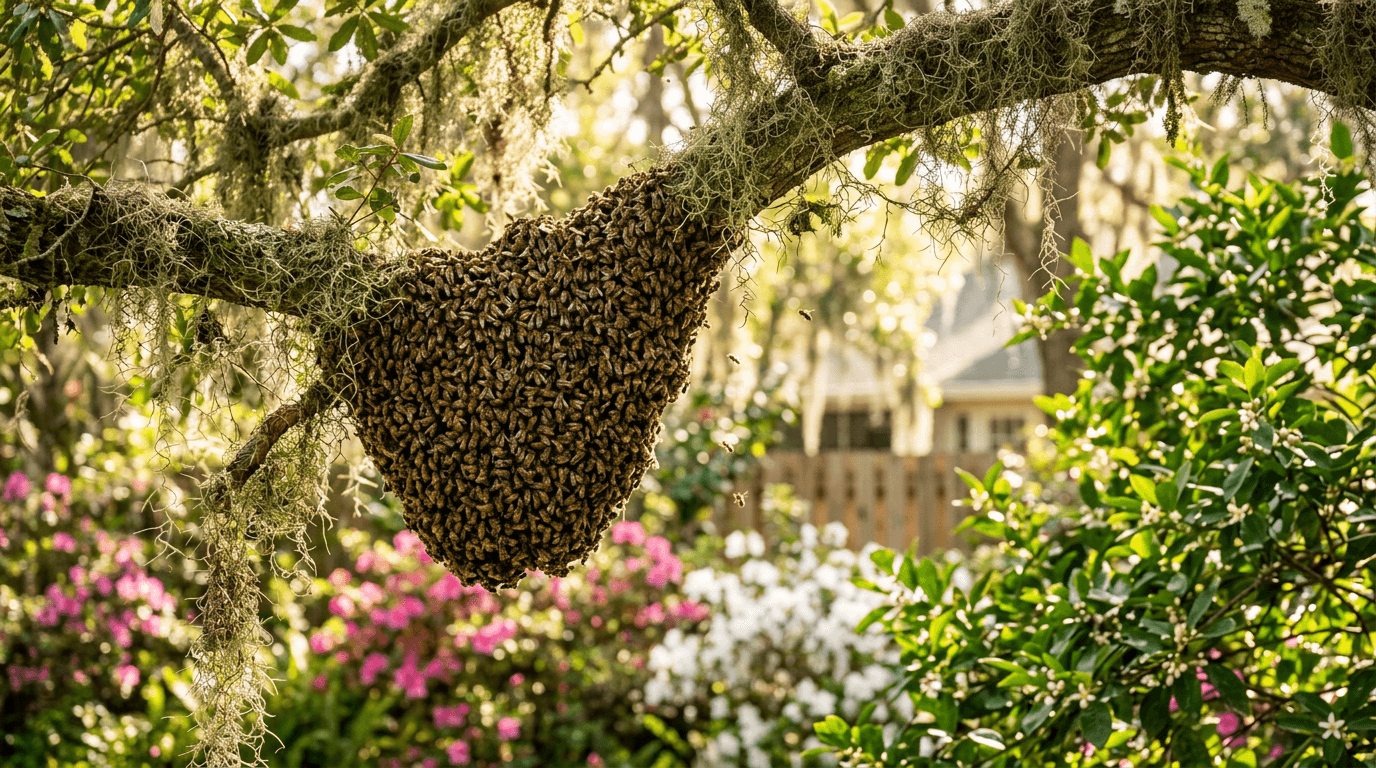
A swarm: a ball of bees out in the open
A swarm is a big cluster of bees hanging on a branch, fence, mailbox, or the side of the house. There's no honeycomb. It's a colony that split in two, and the bees are waiting while scouts find them a new home.
Swarms are usually calm and usually gone within hours to a few days. If it's out of the way, you can often just keep people and pets back and let it leave. The risk is that it moves into your wall. If it's near a door or you don't want to take that chance, I can collect the swarm alive.
A colony: bees flying in and out of a gap
If you see a steady line of bees going in and out of a crack, vent, soffit, or hole in a tree, they've already moved in. Behind that opening is honeycomb, honey, and babies. An established colony doesn't leave on its own. It gets bigger.
That needs a live removal. For colonies inside a house, see bees in walls removal.
Step 3: Skip the "Quick Fixes"
A lot of people search for what kills bees instantly. I understand why. But for honeybees living inside a structure, killing them is the start of a bigger problem, not the end of one.
Spray and bug bombs
Spray kills the bees near the entrance, but the colony is deeper inside. Even if you kill them all, the comb and honey stay behind. Without bees to cool it, comb can melt in Florida heat, leak through drywall, and draw ants and roaches. The smell of old comb also attracts the next swarm to the same spot. Read bee removal vs. extermination for the full comparison.
Bleach, vinegar, and soapy water
These might kill the bees you hit, but they don't reach the comb, and they won't stop a colony. Bleach can also damage your siding and plants. More on that in will bleach kill bees.
Smoke and fire
Beekeepers use a little smoke to calm bees, not to drive them out. Smoke makes bees fill up on honey in case they need to move, and then they settle right back in. Fire near a wall or roof is a good way to lose a lot more than the bees.
Peppermint oil, mothballs, and other repellents
Strong smells might bother bees at the entrance, but they won't move an established colony with comb, honey, and a queen inside. See peppermint oil for pest control.
Sealing the hole
It seems like the obvious fix, but plugging the entrance traps the bees in your wall, and they'll look for another way out, often into your house. Only seal it after the colony and comb are removed.
Step 4: Get Them Removed Alive
For a colony in a wall, roof, soffit, shed, or tree, the fix is a live removal:
- Find the colony. I track the entry point and use a thermal camera to find where the bees are.
- Open it up. Only as much as needed to reach the comb.
- Remove the bees and comb. The bees come out alive with a gentle bee vacuum, along with every piece of comb, honey, and brood.
- Clean up. I remove the honey and wax residue so the spot doesn't draw new bees.
- Rehome the bees. The colony goes to a new hive at one of my bee yards.
You get one upfront price before I start, and it never goes up. Get a free quote.
Step 5: Keep Bees From Coming Back
Once the colony is gone, close the door behind it:
- Seal gaps around soffits, fascia, vents, and where pipes and wires enter the house.
- Screen attic and foundation vents.
- Fill holes in trees or fence posts near the house.
- Don't leave empty hive boxes, old furniture, or stacked containers sitting in the yard. Scouts love them.
The full checklist is in how to bee-proof your home in Florida.
Can I Get Rid of Bees Myself?
If it's a swarm out in the open, waiting it out is a perfectly good plan. If it's an established colony, I don't recommend DIY removal. You'll need protective gear, you'll have to open the structure, and if the comb doesn't all come out, the problem comes back. It's also an easy way to get stung a lot.
The best first step is free: send me a photo and I'll tell you what you've got.
Bees in Orlando? Text Me a Photo
I remove honeybees alive across Orlando and Central Florida, from Winter Park to Kissimmee. Licensed, insured, and registered with the Florida Department of Agriculture. You're happy, or your money back.
Call or text (407) 473-8585, or use the form below to get your upfront price.