
Spring Swarm Season in Florida: What Homeowners Need to Know
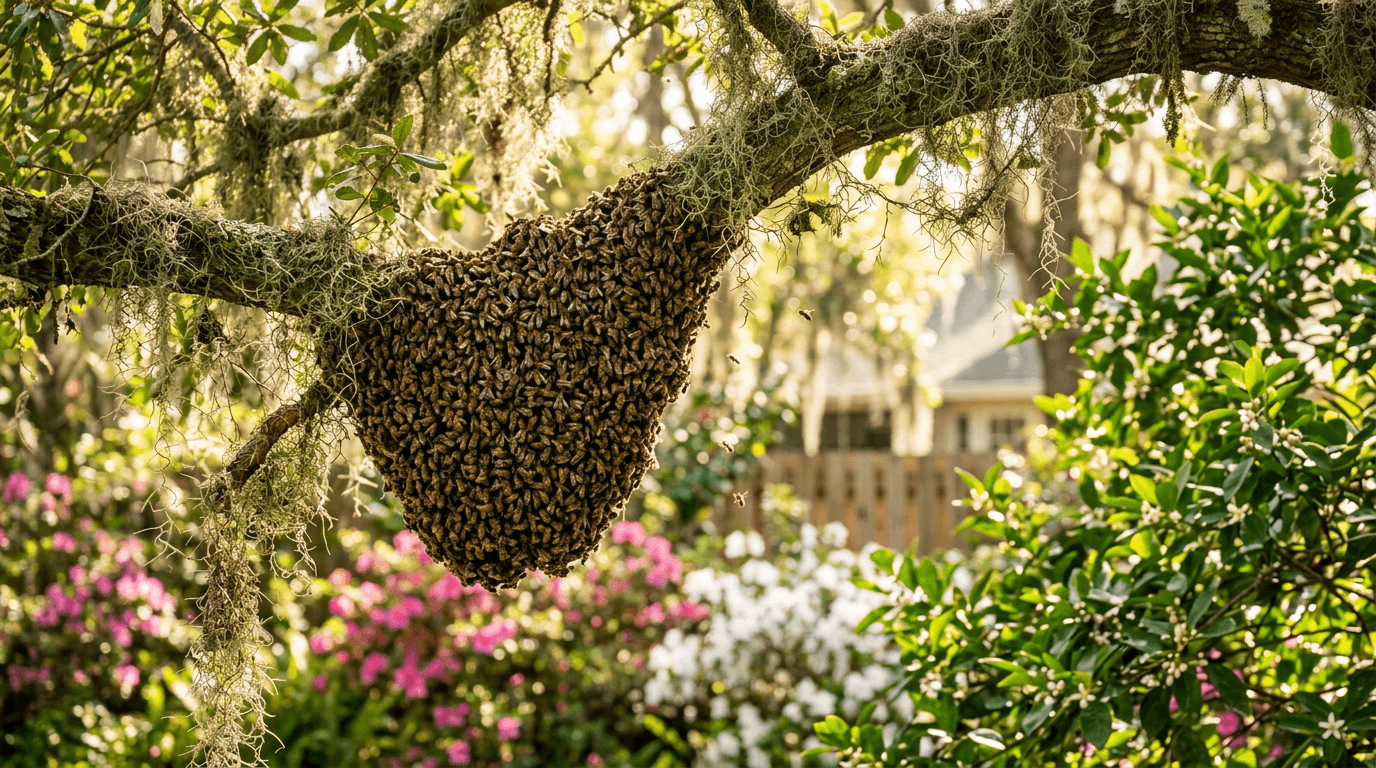
Every spring in Central Florida, thousands of honey bee colonies do the same thing at roughly the same time: they split in half, and one half leaves. That half — a moving cloud of 10,000 to 30,000 bees — lands on a tree branch, fence post, mailbox, patio chair, or in a homeowner's soffit vent, and the phone calls start rolling in.
If you've just walked out your back door in April and found a basketball-sized cluster of bees hanging from your citrus tree, you're in the middle of spring swarm season. It's the single busiest stretch of our year at The Other Bee Guy, and the good news is that swarms are usually far less dangerous than they look. This guide explains what's actually happening, why Florida sees so much of it, and what to do when it happens to you.
For the full playbook on every type of bee encounter, see our Complete Guide to Bee Removal in Orlando. If a swarm has already moved into a wall or vent, skip ahead — that's no longer a swarm, and you can call us at (407) 473-8585 today.
What Is a Bee Swarm, Really?
A swarm is how honey bee colonies reproduce. When a hive gets strong enough — plenty of bees, plenty of food, plenty of drones — the colony splits. The old queen and roughly half the workers fill up on honey and fly out together to find a new home. The other half stays behind with a brand-new queen.
That "flying out together" phase is what you see in the sky: a loud, disorienting cloud of thousands of bees moving as a unit. It looks apocalyptic. It's actually one of the most beautiful things in nature, and one of the least dangerous.
Why Swarms Are Surprisingly Docile
A swarm has:
- No hive to defend. No wax comb, no brood, no stored honey, no territory
- No queen to guard other than the one flying with them
- Full honey stomachs — they filled up before leaving, which physically makes it harder to sting
- A single priority: find a new home before their food runs out
Guard behavior is almost entirely absent. You can stand three feet from a settled swarm and it will ignore you. (We still don't recommend it — but it's true.)
What a Swarm Is NOT
A swarm is not:
- An attack
- An established colony
- A sign your house is infested (yet)
- A pest emergency in most cases
An established colony inside your wall, soffit, shed, or tree hollow is a completely different situation. Read our bees in house removal guide if that's what you're actually seeing.
Why Spring? Why Florida?
Swarm season in Central Florida typically runs mid-February through late June, with a peak from late March through mid-May. Here's why it's so intense here.
The Biology
Honey bees swarm when three conditions line up:
- The colony is strong — tens of thousands of bees
- Food is abundant — a strong nectar flow supports rapid growth
- The hive is crowded — queens run out of laying room, workers build queen cells
Florida's year-round warmth means colonies don't lose members to winter the way they do up north. By February, many hives are already at full strength. Then our spring bloom hits — orange blossom, holly, gallberry, Brazilian pepper holdovers — and colonies explode. Something has to give, and that something is a swarm.
The Geography
Central Florida's combination of:
- Dense suburban tree canopy
- Year-round flowering plants
- Older housing stock with gaps in soffits, fascia, and roof vents
- Large wild and feral honey bee populations (including Africanized genetics)
...creates perfect conditions for both swarm production and swarm landings. Your yard isn't unlucky — it's statistically normal.
Peak Swarm Days
Swarms tend to issue on:
- Warm, calm, sunny late mornings and early afternoons
- Days after a rainy stretch when bees have been hive-bound
- Temperatures above 70°F with low wind
If you see a sudden cloud of bees at 11 a.m. on a beautiful April Saturday, that's swarm weather.
What a Swarm Looks Like
There are two distinct stages — and they look very different.
Stage 1: In Flight (5–30 Minutes)
- A loud, dense cloud of bees moving through the air
- Often 10–40 feet in diameter at its widest point
- Frequently moves across a yard in a "rolling" motion
- Can sound like a distant motor or lawnmower from indoors
This phase is brief. The queen lands somewhere nearby — usually within a few hundred yards of the original hive — and the rest of the swarm follows her down.
Stage 2: Clustered (Few Hours to ~3 Days)
- A dense beard-shaped or football-shaped cluster of tens of thousands of bees
- Most commonly on a tree branch 6–20 feet off the ground
- Can also land on fences, mailboxes, cars, patio furniture, light fixtures, gas meters, playsets, or even on the ground
- Scout bees come and go from the cluster, searching for a permanent home
The cluster is the queen plus her workers keeping her warm and safe while scouts look for a cavity to move into. This is the "why is there a giant ball of bees on my mailbox?" stage.
What to Do If a Swarm Lands on Your Property
The single most useful thing you can do is: nothing dramatic.
Step 1 — Give Them Space
Keep people and pets at least 15–20 feet away. Close nearby doors and windows. If the swarm is near a play area or pool, temporarily fence or rope off the zone.
Step 2 — Observe, Don't Interfere
- Don't spray water
- Don't spray insecticide
- Don't light smoke or fire near them
- Don't hit the cluster with a broom, pole, or hose
- Don't try to capture them without beekeeping experience and gear
Most swarms leave on their own within 24–72 hours. Scouts find a new cavity, dance out directions on the cluster, and the whole mass lifts off and moves on.
Step 3 — Take a Photo
From a safe distance, get one or two clear photos. Note:
- Approximate size of the cluster (softball, basketball, beach ball?)
- Height off the ground
- What it's attached to
- Whether you see any defensive behavior (guarding, chasing)
Step 4 — Call a Beekeeper
A beekeeper can usually collect a swarm humanely in 30–60 minutes. In the Orlando area, give us a call at (407) 473-8585 or reach out through our contact page. Many of the colonies we collect during swarm season become the foundations of our managed hives or go to new beekeepers through our bee nucs and nucleus hive program.
Step 5 — Decide Based on Location
| Where the swarm landed | What we typically recommend |
|---|---|
| High in a tree, no foot traffic | Watch for 24–48 hours; it will usually leave on its own |
| Low branch near a walkway, pool, or play area | Call a beekeeper — safe capture |
| On a mailbox, fence, or patio furniture | Call a beekeeper — blocks use of that space |
| On your car (especially hood or mirror) | Call a beekeeper — don't drive |
| Partially entering a soffit, vent, or wall | Call immediately — they're choosing your house as home |
| On the ground | Unusual — often means an injured or old queen; call a beekeeper |
The One Situation That Is Urgent
If you see a swarm that's actively funneling into a single gap — a vent, soffit opening, crack in siding, knothole in a tree, or hollow in a landscaping feature — you're past swarm stage. Scouts have chosen a home, and the colony is moving in.
Once they're inside, they start building wax comb almost immediately. Within:
- 24 hours — first comb appears
- One week — several combs built, brood laying begins
- Two months — 20,000+ bees and multiple pounds of comb inside the cavity
This is when a manageable swarm becomes a structural infestation. At that point, removal requires opening up the wall, soffit, or roof — vastly more time, money, and mess than catching the swarm on the outside. See our beehive infestation removal guide for what that process looks like.
If you're watching bees pour into a gap in your house right now, stop reading and call — we can often intercept the colony before it fully moves in.
How to Prevent Swarms From Choosing Your House
You can't stop swarms from flying. You can make sure your house isn't one of the places they decide to move into.
Seal Common Entry Points
Scout bees are methodical. They inspect dozens of cavities looking for a space that's:
- Between 10 and 40 liters of volume
- Dry, defensible, and shaded
- Accessible through a single small opening
- Ideally 6+ feet off the ground
Your soffits, wall cavities, roof vents, and chimneys check every box. Seal them:
- Install 1/8-inch hardware cloth over every attic vent, gable vent, and soffit vent
- Cap every chimney — a top-entry flue is a five-star bee hotel
- Fill old carpenter bee holes — these are pre-drilled entrances. See our carpenter bee prevention guide
- Caulk or screen openings around plumbing penetrations, dryer vents, and utility entries
- Check around roof flashing and where fascia meets soffits — these are common gaps we find mid-removal
- Seal gaps between siding and trim — especially on older homes
Don't Leave Empty Attractants in Your Yard
Empty spaces with old beeswax smell are especially attractive to scouts. Common culprits:
- An old beehive you haven't fully cleaned out
- An outdoor trash can or recycling bin with lingering honey residue
- An unused shed, well housing, or play structure
- A dead tree with a hollow
- Stacked lumber or firewood with cavities
Respond Quickly to Scout Bees
A single scout bee visiting the same spot on your house multiple times a day means your home is on the shortlist. You have a short window — usually a few days — to seal the entry before a swarm arrives. For more on identifying scouts, see our post on how to know if your bee nest is honey bees.
Consider a Preventive Inspection
Before swarm season each year (January–February), walk your property and look for new gaps. If you've had bees before, pay extra attention to that area — scout bees will revisit locations where previous swarms did well, even years later. This is why we always remove all residual comb and treat cavities after a removal.
What Happens to the Bees We Collect
This is the fun part. When we catch a swarm, the bees aren't going anywhere bad. They go to one of three places:
- Our managed apiaries — to become production colonies for our local honey
- Trusted local beekeepers in our network through our bee relocation program
- New hobbyist beekeepers as starter colonies through our education and mentorship program
Every swarm we catch is a colony that survives. Over the course of a Central Florida spring, that's hundreds of colonies and tens of millions of bees that would otherwise be sprayed, stuck in walls, or lost. It's one of the most rewarding parts of what we do.
Spring Swarm Season by the Week
A rough calendar of what Central Florida homeowners can expect:
| Week | Typical Activity |
|---|---|
| Late Feb | First scout bees appear; early swarms on warm days |
| Early March | Citrus bloom begins; swarm activity ramps |
| Mid-March | First significant wave of swarms statewide |
| Late March to mid-April | Peak — most swarm calls of the year |
| Late April | Swarms still frequent; secondary swarms (cast swarms) begin |
| Early May | Activity remains strong, especially after rain |
| Late May | Volume starts to taper |
| Early to mid-June | Tail end of the main season |
| Late June onward | Occasional swarms, mostly from strong colonies under stress |
If you're reading this in April, you're right in the middle of it.
Are Swarms Ever Dangerous?
Three situations change the calculation.
Africanized Swarms
Swarms from Africanized honey bee colonies can be more defensive, especially after they've clustered and been disturbed. Florida has established Africanized bee populations, and visually they're identical to European honey bees. If a swarm behaves aggressively — chasing people walking by, responding to a closed car door 30 feet away, reacting to lawn equipment — treat it as an Africanized situation and call us.
Swarms That Cluster Near High-Traffic Areas
Even docile swarms become a problem when they land somewhere that people have to pass. Front doorways, mailboxes, pool decks, playsets, and pet runs are all reasons to get a beekeeper out rather than waiting.
Swarms That Don't Move On in 3+ Days
A swarm that hasn't relocated within 72 hours usually means scouts are having trouble finding a home — which often means they're about to try harder and broader, including your house. After three days, call.
Frequently Asked Questions
Will the swarm sting me?
Very unlikely unless you handle it, squeeze it, or sprinkle it with water or insecticide. Swarms in cluster stage have essentially zero defensive behavior. Still, keep a respectful distance.
How long will a swarm stay?
Most leave within 24–72 hours once scouts identify a new cavity. If it's still there after three days, call a beekeeper.
Should I spray the swarm?
Please don't. Spraying a swarm kills the colony, traumatizes the surviving bees, and — if they were headed elsewhere — doesn't accomplish anything useful. Beekeepers can usually collect a swarm in under an hour, for free or for a small fee.
Will the bees come back to the same spot next year?
The individual swarm won't, but similar locations often attract new swarms over years. This is especially true if a previous colony nested nearby — the residual wax scent draws scouts. Proper sealing and cleanup after any past removal prevents this.
Can I keep the swarm as my own backyard hive?
Only if you've done the prep work — equipment, a hive body, a legal location under Florida beekeeping regulations, and ideally some mentorship. Reach out through our education and mentorship page if you're interested in starting out.
How much does it cost to have a swarm collected?
We usually collect accessible swarms for free or for a small gas/time fee in the Orlando metro during swarm season. Swarms at significant height, in difficult locations, or on the edge of our service area may carry a fee. We'll always tell you up front.
I think bees are moving into my wall — is that a swarm?
Not anymore. Once bees are going into a cavity, they've graduated from swarm to colony, and removal is a structural job. See our beehive infestation removal guide and call us — catching the colony early is far cheaper than waiting.
Is a swarm more common in certain Orlando neighborhoods?
Older neighborhoods with larger tree canopies — Winter Park, College Park, Audubon Park, parts of Maitland and Altamonte Springs — get more calls. So do areas near citrus groves, lakes, and wooded preserves. Newer developments with sealed modern construction see fewer home-infiltration events but still plenty of cluster landings.
Related Articles
- Complete Guide to Bee Removal in Orlando
- When to Call a Professional Bee Remover
- Bee Removal vs. Extermination: Why It Matters
- Bees in House? Safe Removal & Relocation
- Beehive Infestation Removal
- Africanized Bees vs. Honey Bees
- How to Know If Your Bee Nest Is Honey Bees
- Bee Dance Communication
Got a Swarm in Your Orlando Yard? Call The Other Bee Guy.
Spring swarm season is the time of year we do our best work — catching colonies in the air before they become a problem in someone's wall. If you've spotted a cluster in your yard, or you think bees are scouting your home, don't spray and don't panic.
Call (407) 473-8585 or request a swarm collection online. We serve Orlando, Winter Park, Kissimmee, Lake Nona, Altamonte Springs, Sanford, and the surrounding Central Florida communities. The bees go to a good home — and so does yours.