
How Bees Make Honey: The Full Process
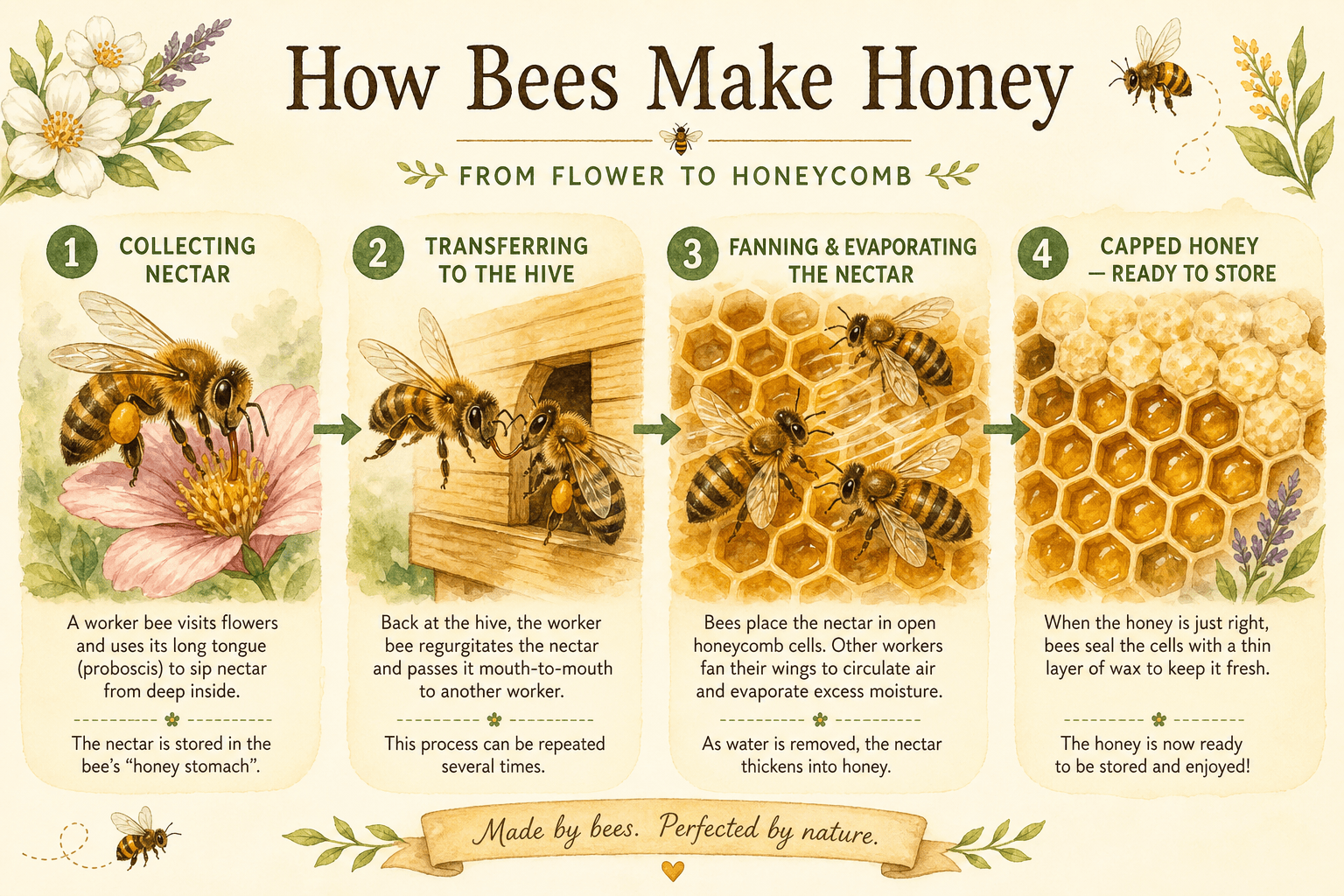
Honey is one of nature's most remarkable creations. But have you ever stopped to wonder exactly how bees make honey? The journey from a flower's nectar to the golden honey in your jar is a fascinating feat of teamwork, chemistry, and instinct.
At The Other Bee Guy, we work with honey bee colonies every day, and the honey production process never stops amazing us. In this guide, we'll walk you through every step—from the first sip of nectar to the final capped comb.
Curious what happens to the honey after this? Learn about raw honey vs. processed honey.
Why Do Bees Make Honey?
Before we dive into how, let's answer why. Bees don't make honey for us—they make it for themselves.
Honey is the colony's food source, especially during times when flowers aren't blooming (like winter up north or Florida's summer dearth). A strong colony stores honey as a long-lasting, energy-rich food supply to survive lean times.
The bees simply make more than they need—which is what allows beekeepers to harvest the surplus.
Step 1: Foraging for Nectar
The honey production process begins with forager bees—older worker bees whose job is to gather resources.
- Foragers fly up to 3 miles from the hive searching for flowers
- They use their long, tube-like tongue (proboscis) to sip nectar from blossoms
- Nectar is a sugary liquid produced by flowers to attract pollinators
- A forager visits 50–100 flowers per trip
The nectar is stored in a special organ called the honey stomach (or crop), separate from the bee's digestive stomach.
Step 2: The Enzyme Transformation Begins
Here's where the magic starts. Even before the forager returns home, an enzyme called invertase begins breaking down the complex sugars in the nectar (sucrose) into simpler sugars (glucose and fructose).
This enzymatic process is the first step in transforming thin, watery nectar into thick, stable honey.
Step 3: Passing It Along (Trophallaxis)
When the forager returns to the hive, she doesn't store the nectar herself. Instead, she passes it mouth-to-mouth to a younger house bee—a process called trophallaxis.
- The nectar is transferred from bee to bee
- Each transfer adds more enzymes
- This further breaks down the sugars
- It also begins reducing the moisture content
This bee-to-bee relay can happen several times, refining the nectar with each pass.
Step 4: Depositing Nectar Into the Comb
Once the nectar is sufficiently processed, house bees deposit it into the hexagonal cells of the honeycomb.
At this stage, the nectar is still quite watery—containing around 70% water. It's not yet honey. If it were sealed now, it would ferment and spoil. So the bees have more work to do.
Step 5: Fanning and Evaporation
This is one of the most impressive parts of how bees make honey. To turn watery nectar into thick honey, bees must remove most of the water.
How do they do it? They fan their wings.
- Thousands of bees beat their wings to create airflow
- This circulates warm air through the hive
- The moving air evaporates water from the nectar
- The warmth of the hive (around 95°F) speeds the process
Over time, the nectar's moisture drops from ~70% to about 17–18%. This concentration is key—it makes honey stable and resistant to spoilage.
Step 6: Capping the Comb
Once the honey reaches the ideal moisture content (below ~18.6%), the bees know it's ready for long-term storage.
They seal each cell with a thin layer of beeswax, creating an airtight cap. This "capped honey" can be stored almost indefinitely without spoiling—one of the reasons honey is such a perfect survival food.
For beekeepers, capped comb is the signal that honey is ready to harvest.
The Honey-Making Process at a Glance
| Step | What Happens |
|---|---|
| 1. Foraging | Bees collect nectar from flowers |
| 2. Enzymes | Invertase breaks down sugars |
| 3. Trophallaxis | Nectar passed bee-to-bee, adding enzymes |
| 4. Deposit | Nectar placed in honeycomb cells |
| 5. Fanning | Wings evaporate water |
| 6. Capping | Cells sealed with wax |
How Much Honey Can a Colony Make?
The numbers behind honey are staggering:
- A single worker bee makes about 1/12 of a teaspoon of honey in her entire lifetime
- To make 1 pound of honey, bees fly the equivalent of 55,000 miles and visit around 2 million flowers
- A strong colony can produce 60+ pounds of surplus honey in a good year
This is why every jar of honey represents the collective effort of thousands of bees.
Why This Matters for Pollination
As bees forage for nectar, they inadvertently transfer pollen between flowers—pollinating plants in the process. This makes honey production part of a much bigger ecological role.
That's why saving bees matters so much. When we perform bee removal and relocation, we're preserving colonies that will continue both making honey and pollinating Florida's plants.
Frequently Asked Questions
How long does it take bees to make honey?
It varies, but bees can transform nectar into capped honey within a few days to a week, depending on nectar flow and hive conditions.
Is honey bee vomit?
Not exactly. Nectar is stored in a special "honey stomach" separate from the digestive system, and it's regurgitated during processing. It's better described as a specialized food-processing organ, not true vomiting.
How do bees remove water from honey?
Bees fan their wings to circulate warm air through the hive, evaporating water from the nectar until it thickens into honey.
How much honey does one bee make?
A single worker bee produces only about 1/12 of a teaspoon of honey in her lifetime.
When is honey ready to harvest?
Honey is ready when bees have capped the comb with wax and the moisture content is below about 18.6%.
Support Florida's Honey Bees
Now that you know how bees make honey, you can appreciate just how special every jar really is. The colonies we rescue produce delicious raw Florida honey—wildflower, orange blossom, and saw palmetto varieties.
Want to taste the results of this incredible process? Explore our local honey or contact us to learn more. Every jar supports our mission of saving bees, one colony at a time.